Meta Description: UAD 3.6 is transforming appraisal data workflows for lenders and AMCs. Understand what the Uniform Appraisal Dataset 3.6 changes mean for your operation and how to get ready.
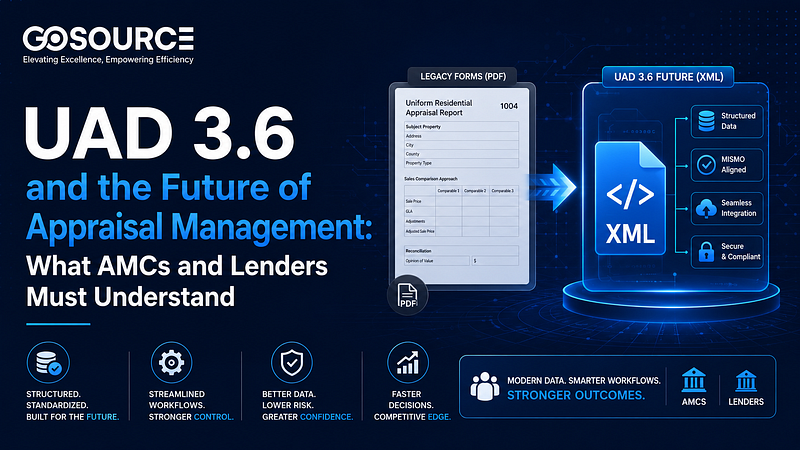
There’s a reason UAD 3.6 keeps coming up in every appraisal management conversation right now. It’s not just another compliance checkbox. For AMCs and lenders, it represents a fundamental change in how appraisal data flows through your operation from order to placement, all the way through underwriting.
If you manage a panel of appraisers, review reports, or make credit decisions based on valuations, UAD 3.6 touches your work directly. Here’s what you need to understand.
A Quick Recap: What Is UAD 3.6?
UAD 3.6 is version 3.6 of the Uniform Appraisal Dataset, the joint Fannie Mae and Freddie Mac standard that governs how appraisal reports are structured and delivered for conventional mortgage transactions.
The previous UAD framework, in place since 2011, standardized certain codes and field definitions but was still built around static PDF-style forms. UAD 3.6 replaces that model with a fully dynamic, data-driven reporting structure. Appraisers capture individual structured data points. The output is machine-readable XML aligned with MISMO industry standards, built for direct API integration with lender and GSE platforms.
For a complete breakdown of the standard itself, this resource covers everything: What Is UAD 3.6? | Complete Guide to the Future of Appraisal Reporting
What UAD 3.6 Means for AMC Operations
For appraisal management companies, the implications cut across almost every part of the operation.
Order Management and Workflow: The way you receive, route, and track appraisal orders will need to adapt. UAD 3.6’s data-driven model means the order itself carries more structured information upfront, property details, assignment scope, and complexity indicators. Your workflow systems need to be able to read and act on that data.
Appraisal Review: This is arguably the area of biggest impact for AMCs. Right now, review is largely a human process, with reviewers reading PDF reports, checking fields, and flagging issues. UAD 3.6 makes the data machine-readable, which opens the door to automated review workflows. Systems can validate data fields, flag inconsistencies, and surface issues without a human reading every line of the report. That doesn’t eliminate the need for skilled review staff. But it shifts the focus. Reviewers stop spending time on data entry errors and format issues and start spending more time on genuine analytical questions, market support, comparable selection, and adjustment methodology.
Vendor Panel Readiness: Your appraiser panel needs to be UAD 3.6-ready. That means compliant software and a solid understanding of the new data structure. Part of your responsibility as an AMC will be communicating clearly with your panel about the transition timeline and making sure your vendor relationships include appraisers who are ahead of the curve.
Quality Control: UAD 3.6 introduces built-in data validation at the point of entry. But that doesn’t make your QC process irrelevant; it makes it evolve. Your QC standards need to be updated to align with the new data model. The metrics you track, the tolerances you set, the escalation triggers you use, all of it gets revisited through the lens of structured data.
What UAD 3.6 Means for Lenders
For lenders, the story is largely about speed, accuracy, and integration.
Faster Underwriting When an appraisal arrives as structured XML rather than a PDF, your underwriting team doesn’t have to manually locate and extract data. Systems can read the report directly, cross-reference it with AUS outputs, and flag issues automatically. Loan cycle times get shorter. That’s a really competitive advantage.
Fewer Revision Requests. One of the biggest friction points in the appraisal process is revision cycles, the back-and-forth between lenders, AMCs, and appraisers over missing data, inconsistent formatting, or unclear methodology. UAD 3.6 validation requirements mean many of those issues get caught before the report ever leaves the appraiser desk. You get cleaner data on the first submission.
Better Audit Trails and Data Governance. Structured, standardized appraisal data is dramatically easier to audit, archive, and analyze. Lenders who embrace UAD 3.6 early will build richer datasets for portfolio analysis, risk modeling, and regulatory reporting.
GSE Alignment Fannie Mae and Freddie Mac are driving this standard because it aligns with where they want the secondary market to go. Early adoption isn’t just about operational efficiency; it’s about positioning your loan portfolio for smooth GSE delivery as the standard becomes mandatory.
The Technology Question
No conversation about UAD 3.6 is complete without talking about technology. The shift from PDF-based to XML-based, MISMO-aligned appraisal reporting requires honest evaluation of your current platforms:
- Can your order management system ingest and route UAD 3.6-structured data?
- Does your review software support automated validation against UAD 3.6 field definitions?
- Are your LOS and AUS integrations ready to consume structured appraisal XML?
- Do you have the API infrastructure to connect to GSE delivery systems under the new standard?
These aren’t questions to save for later. Technology procurement cycles take time. If your current vendor isn’t on a clear UAD 3.6 roadmap, that conversation needs to happen now.
A Practical UAD 3.6 Transition Plan
Here’s a straightforward framework to get ahead of this:
Step 1: Assess Your Current State. Map your current appraisal workflow from order to delivery. Identify every touchpoint where data is captured, reviewed, or transmitted. That’s your change impact map.
Step 2: Engage Your Technology Vendors. Push your software providers for concrete answers. Not “we’re working on it,” ask for roadmaps, timelines, and demo environments.
Step 3: Communicate With Your Appraiser Panel Early. Your panel needs time to prepare, too. AMCs that give their appraisers early, clear guidance will have a much smoother transition than those who drop the mandate on short notice.
Step 4: Revise Your QC and Review Frameworks. Start drafting what your UAD 3.6-era quality standards look like. What data fields will you validate automatically? What thresholds trigger manual review?
Step 5: Train Your Team. Your review of staff, operations team, account managers, and everyone who touches the appraisal workflow needs to understand what UAD 3.6 changes. Don’t underestimate the training investment required.
The Bigger Picture
UAD 3.6 is part of a broader industry direction. The mortgage business is becoming more data-driven at every level: origination, underwriting, servicing, and secondary market delivery. Appraisal has been one of the last holdouts of document-based, human-read reporting. That era is ending.
For AMCs and lenders who adapt proactively, UAD 3.6 isn’t a burden. It’s an opportunity to build faster, more accurate, and more defensible appraisal operations. The companies that figure out early will have a meaningful edge over those treating it as just another compliance deadline.
Stay connected to the latest appraisal industry insights, standards updates, and operational guidance at the Go Source Valuation resource library.